
 Business License

How to Choose the Right Thermal Imaging Camera from China?
China has emerged as one of the most competitive sourcing destinations for thermal imaging cameras globally. With breakthroughs in infrared detector R&D, intelligent focusing algorithms, automated manufacturing, and supply chain optimization, Chinese thermal camera manufacturers now lead in both handheld and fixed thermal cameras. Beyond competitive pricing, they deliver superior measurement accuracy, system integration capabilities, and exceptional reliability—key advantages for global buyers seeking thermal imaging cameras from China.
Whether you require industrial inspections, electrical equipment monitoring, or production process control, selecting the right Chinese thermal imaging camera enables informed purchasing decisions. This guide explores competitive advantages, key selection criteria, and safe procurement practices for thermal cameras sourced from China.
1. Why Choose Thermal Imaging Cameras Made in China?

1) Significant Price Advantages
Chinese thermal cameras offer clear pricing benefits. Manufacturers operate comprehensive supply chains and scaled production systems, localizing everything from infrared detector chips and lens modules to final assembly. This vertical integration enables competitive pricing against Western counterparts without quality compromise. The advantage stems from mature manufacturing processes, efficient production models, and integrated supply chain infrastructure rather than reduced quality standards.
2) Diverse Product Portfolio
Chinese manufacturers provide extensive product lines spanning handheld and fixed thermal cameras, addressing everything from portable field inspections to fixed online monitoring. Buyers select configurations including resolution, focal length, temperature range, and communication interfaces based on specific applications, with software customization and OEM services available. This flexibility prevents over-investment and eliminates functionality gaps.
3) Rapid Technological Innovation
Chinese companies have achieved significant breakthroughs in core technologies, particularly in pixel miniaturization and AI algorithm integration. Leading manufacturers like Raythink now produce uncooled infrared detectors with 12μm pixel sizes and thermal sensitivity (NETD) reaching 25mK–40mK, substantially improving image clarity and measurement precision. Continuous advances in smart temperature analysis, trend recording, and anomaly detection meet diverse industrial inspection and preventive maintenance demands.
4) Complete Supply Chain Assurance
China maintains integrated thermal imaging industries from infrared detector chip production through final assembly. This vertical integration reduces costs while ensuring supply stability and rapid response capabilities. Logistics networks guarantee efficient delivery, typically requiring only 10–14 days from order confirmation to shipment.
2. Key Features to Evaluate When Selecting Thermal Imaging Cameras
1) Spectral Range and Application Matching

Long-wave infrared (LWIR, 8–14μm) remains the mainstream choice for thermal cameras, providing excellent atmospheric penetration and thermal radiation intensity suitable for most industrial inspection, electrical monitoring, and building diagnostics applications. Both handheld and fixed products adopt LWIR technology as standard.
LWIR detectors deliver high efficiency at ambient temperatures with relatively lower costs, providing optimal value. For specialized requirements, some manufacturers offer mid-wave infrared (MWIR, 3–5μm) or short-wave infrared (SWIR, 0.9–1.7μm) options for high-temperature metals or special material detection, though at premium pricing.
2) Resolution and Pixel Size

Resolution directly impacts image clarity and temperature measurement accuracy. Mainstream handheld and fixed thermal cameras offer resolutions from 256×192, 384×288, 640×512 to 1280×1024. Smaller pixel dimensions (like 12μm versus 17μm) enable higher spatial resolution, detecting subtle temperature variations and producing sharper thermal imagery in equivalent formats.
When selecting resolution, balance observation distance and application requirements. High-precision diagnostics and research applications benefit from 640×512 or higher resolution. Basic inspections like electrical maintenance adequately utilize 256×192 or 384×288.
3) Temperature Measurement Range and Accuracy

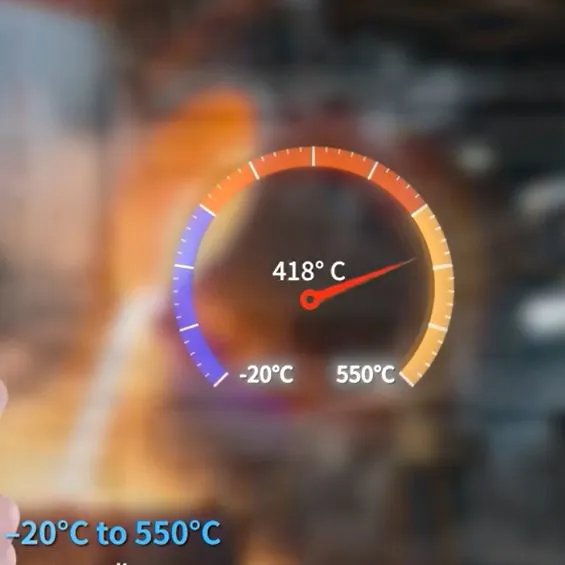
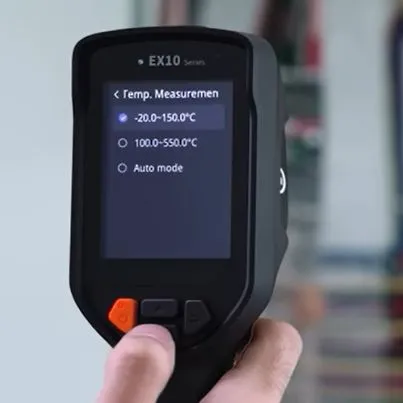
Temperature measurement ranges vary by model specification. Handheld products typically cover –20°C to 150°C for ambient monitoring, with some extending to 100°C–550°C or 650°C. Certain fixed models reach –20°C to 650°C or even 0°C to 2000°C for ultra-high-temperature measurement. Switchable temperature ranges optimize accuracy across different operational conditions.
Measurement accuracy typically reaches ±2°C or ±2% of reading. Thermal sensitivity (NETD) serves as a critical performance indicator—mainstream products achieve NETD below 40mK, with premium models reaching 25mK–35mK. Smaller NETD values enable more precise temperature detection and finer imaging detail.
4) Detection Distance and Field of View

Detection distance depends on lens focal length, detector resolution, and target dimensions. Handheld products typically offer multi-focal-length options from 3.2mm to 60.9mm; fixed models provide selections from 4.1mm to 225mm. Longer focal lengths extend recognition distances but narrow the field of view (FOV); shorter focal lengths broaden the coverage area.
Ultra-wide-angle lenses (approximately 56°×42°) suit close-range broad coverage, standard lenses (approximately 25°×20°) balance distance and coverage, while telephoto lenses (approximately 7°×6°) enable long-distance precise monitoring.
5) Focusing Methods and Operational Convenience

Focusing options include fixed focus, manual focus, autofocus, and motorized focus mechanisms. Fixed focus suits close-range rapid inspection; manual focus provides precise imaging control; autofocus handles dynamic targets or variable distances; motorized focus in fixed models supports remote adjustment capabilities.
Premium handheld products support laser-assisted focusing, one-button center focus, single-touch autofocus, and continuous autofocus modes, significantly reducing operator error and improving on-site inspection efficiency.
6) Frame Rate and Dynamic Response


Frame rate represents the number of images captured and output per second. Handheld products typically operate at 25Hz or 30Hz; fixed models achieve 25Hz to 50Hz. Higher frame rates deliver smoother imagery, effectively capturing rapidly changing temperature data while preventing blurring or transmission delays—essential for real-time product line monitoring and dynamic process analysis.
Dynamic response also depends on signal processing speed and image algorithms. Rapid data refresh combined with efficient thermal signal processing maintains stable imaging in fast-changing environments.
7) Communication Interfaces and System Integration
Handheld products typically include USB, HDMI, Wi-Fi, and Bluetooth interfaces; fixed models support RJ45 Ethernet, RS-485, USB, and HDMI. Mainstream products support standard protocols including ONVIF, GB28181, Modbus TCP, MQTT, and RTSP, enabling seamless integration with video management systems (VMS), network video recorders (NVR), and industrial automation platforms.
Some products also offer SDK packages and API interfaces supporting custom development and data sharing, meeting specialized system integration requirements.
8) Housing Quality and Durability

Most handheld products feature an IP54 protection rating (dust and splash resistant), pass 2-meter drop testing, and hold vibration resistance certifications with operating temperatures typically ranging from –10°C to 50°C or –20°C to 55°C. Fixed products typically achieve IP67 protection (complete dust resistance, temporary water immersion capability) with wider operating ranges reaching –40°C to 70°C.
Additionally, handheld devices often incorporate large-capacity rechargeable lithium batteries supporting 6–15 hours of runtime; certain models offer fast charging and hot-swappable battery options.
3. Raythink Popular Thermal Camera Recommendations

Recently Posted
-
International Day of Forests 2026: Safeguarding Forests and Economies with Thermal Imaging
April 24, 2026The theme of the International Day of Forests 2026, “Forests and Economies,” highlights the vital role forests play in supporting Read More
 -
Raythink Releases EV Lithium-ion Battery Thermal Safety White Paper
April 21, 2026As electric vehicles (EVs) continue their rapid global adoption, ensuring high-energy lithium-ion battery safety has become a crit Read More
 -
Application of Gas Detection Thermal Cameras in Environmental Monitoring
April 16, 2026In industrial production, energy transportation, cold chain operation and other scenarios, the leakage of VOCs (Volatile Organic C Read More
 -
Raythink’s AI-Powered Thermal Outdoor Security Cameras Protect Communities and Assets
April 14, 2026As winter conditions continue to impact parts of the United States and Europe, organizations are once again facing operational cha Read More

Contact Us
Recommended Products
-
 WN2 Imaging Thermal Module | Uncooled 12μm Infrared Camera Core With Multi-Resolution OptionsNegotiableMOQ: 1 Box
 -
640×512 High Resolution Uncooled Infrared OGI Camera RG630F for Petrochemical Gas SafetyUS$ 99999MOQ: 1 Set
-
RG630F AI Powered Handheld OGI Camera for Non-Contact Industrial Gas Leak Visual DetectionUS$ 99999MOQ: 1 Set
-
High-Sensitivity RG630C OGI Camera With Real-Time Gas Leak Monitoring & GPS TrackingNegotiableMOQ: 1 Set
-
Industrial-Grade RG630C OGI Camera for Oil, Gas and Petrochemical Leak MaintenanceNegotiableMOQ: 1 Set

-
AI-Powered RG630C Camera for Methane, Ammonia and SF6 Gas Leak VisualizationNegotiableMOQ: 1 Set
-
High-Resolution RG630C OGI Camera Compliant With EPA Appendix K for Gas Leak InspectionsNegotiableMOQ: 1 Set
-
RG630C Handheld OGI Camera for Non-Contact Visual Gas Leakage Detection & Safety MonitoringNegotiableMOQ: 1 Set
-
EX10 Infrared Thermal Imager for Precise HVAC Efficiency & Circuit Overheating ChecksNegotiableMOQ: 100 Sets
-
High-Performance EX10 Thermal Camera Enhancing Safety in Electrical MaintenanceNegotiableMOQ: 100 Sets
-
EX10 Thermal Imaging Device for Accurate Electrical & HVAC InspectionsNegotiableMOQ: 100 Sets
-
PC464A1 IP66 Rated Dual-Spectrum PTZ Camera With Thermal Imaging and 500m Surveillance RangeNegotiableMOQ: 100 Pieces
-
Raythink PC464A1 Dual-Spectrum PTZ Camera for Long-Range Perimeter Security and Fire DetectionNegotiableMOQ: 100 Pieces
-
PC464A1 Dual-Spectrum PTZ Camera With 30x Optical Zoom and AI Analytics for Critical Infrastructure SecurityNegotiableMOQ: 100 Pieces
-
High-Resolution 1280×1024 Uncooled VOx Infrared Thermal Imaging Module With LY300 ASICNegotiableMOQ: 1 Box
-
Long Wave Infrared Thermal Imaging Module TC 2-C With LY300 ASIC for Industrial MonitoringNegotiableMOQ: 1 Box
-
WN2 Series Uncooled Infrared Module With High-Frame-Rate 12μm WLP Detector for Intelligent Platform IntegrationNegotiableMOQ: 1 Box
-
RT630 Rugged Thermal Imaging Camera for Harsh Industrial Environments & Portable Electrical ChecksNegotiableMOQ: 50 Pieces
-
User-Friendly RT630 Thermal Camera With 8-Hour Battery & LCD Display for Field DiagnosticsNegotiableMOQ: 50 Pieces
-
Durable RT630 Thermal Imager With Enhanced Accuracy ±2°C/2% for Reliable Preventive MaintenanceNegotiableMOQ: 50 Pieces

